Arnout Nuijt
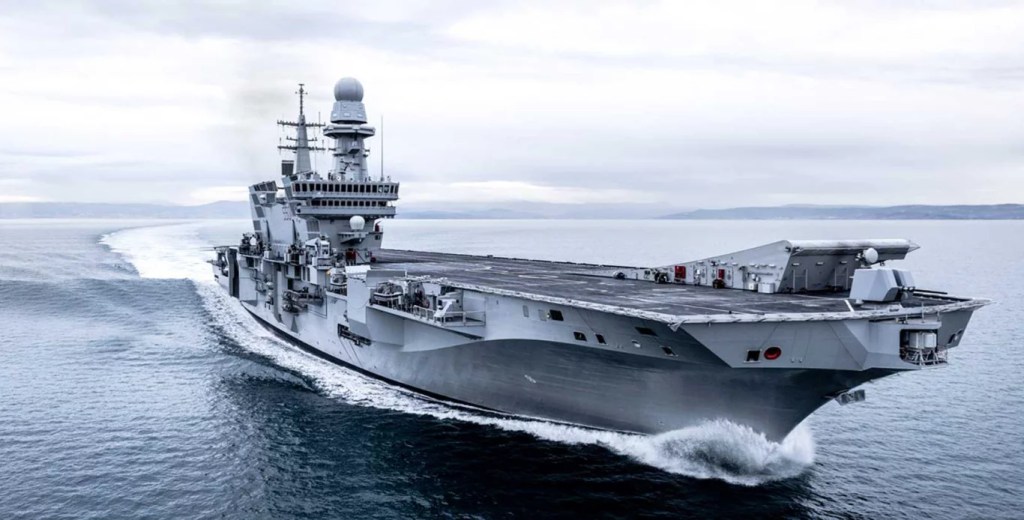
Italian aircraft carrier Cavour (Fincantieri)
There is one country in Europe that is seriously working on a foreign and security policy based on national interest, without being distracted by obligatory European cooperation rituals. That country is Italy. Unfortunately, the Italian efforts in the international and defense field remain underexposed in most of the international press, but its government is achieving what many European politicians can only dream of. And now the country has announced an expansion of its navy that is unparalleled.
Yes, the Italian army does seem to be somewhat behind, with, among other things, its now more or less obsolete fleet of locally built Ariete tanks. But to be fair, Italy is in very little danger of being attacked over land. Nevertheless, a mega order, to be carried out by the German Rheinmetall firm in cooperation with local industrial giant Leonardo, should deliver a brand new and hyper modern fleet of tanks and armored vehicles that the country will have to make do with for the next twenty to thirty years.
On paper, Italy has both one of the strongest European air forces and navies. With around a hundred F35 stealth fighters and the same number of Eurofighter Typhoons in its inventory, the country can easily control its own vast airspace (and that in a wide area in the Mediterranean). Its own industry also benefits. The Italian Leonardo firm, the only producer of the F35 in Europe, is expected to profit enormously from additional orders for the aircraft from other European countries. Moreover, as part of the European Eurofighter consortium, the company also plays a crucial role in the delivery of additional Typhoons that have already been ordered for the Italian air force.
In addition to Leonardo, a champion in the field of aerospace, artillery and vehicles, Italy also has the shipbuilder Fincantieri at its disposal, one of Europe’s most important suppliers of naval vessels. A third major defense company, Iveco Defence Vehicles or IDV, will be sold to a suitable party by parent company Iveco this year. There are plenty of candidates, including the aforementioned German-Italian combination of Rheinmetall and Leonardo, the British-American BAe firm, the Spanish Indra company, as well as the German-French KNDS and the Czech CSG firms. IDV is not just anyone and is the designer of the future standard amphibious armored vehicle of the US Marine Corps.
Of course, Italy is a one of Europe’s larger country, with a considerable GDP. But the country’s industry is able to meet almost all the needs of the Italian armed forces and is also an important exporter. Italy, together with the UK and Japan, is also participating in one of the most important and strategic development programs in the field of defense. The Global Air Combat Programme will result in a sixth generation jet fighter, the successor to the Typhoon and possibly of the F35 (alas without American input). The country has also developed various frigates and corvettes for the navy together with other European countries. Fincantieri even sold a frigate design to the US, although the industry in that country turned out to be hardly able to build the vessel after adjustments by the American authorities. It is striking that Italy no longer likes to work together with France, which it sees as a political and diplomatic rival and as an unreliable industrial partner.
In the meantime, the country is making giant leaps in the diplomatic field. The focus is not only on Africa with a charm offensive based on the so-called Mattei plan. No, Italy, which has left the Chinese Belt and Road program in an undiplomatic big way, has signed at least ten defense and other strategic pacts in the past few months, with Argentina, Japan, Israel, Turkey, Saudi Arabia, India, etc. The country is also explicitly focusing its diplomatic and military activities on the Far East, the Indo-Pacific. For example, an Italian Carrier Strike Group, led by the aircraft carrier Cavour, sailed through the region for five months in 2023.
The broad outlines of Italy’s security policy are clear. The country supports Ukraine, but in a sensible way and in moderation. The country is not up to its neck in it like most Northwest European states. Together with Turkey, the country is trying to appease the pro-Russian warlord Haftar in the former colony of Libya. That seems to be working because a large Italian trade mission will be received in Benghazi this month. Together with Turkey, the country also supports the Somali government and the armed forces in this former colony will be equipped with Turkish combat helicopters and Italian armored vehicles. Stabilization of North and North-East Africa is of vital importance to Italy, for the energy supply, but also in the fight against illegal migration and human trafficking.
For all these global activities a strong navy is needed and this is being modernized and even expanded considerably in the past few years. The most striking is the recent announcement by the Italian navy or Marina Militare, that it is working on a nuclear-powered aircraft carrier, as a successor to the Cavour. New guided missile destroyers and submarines will also be equipped with nuclear reactors, conveniently manufactured by Fincantieri. The Marina Militare explained that it wants to be able to operate independently in the Indo-Pacific. Fincantieri is also said to be working on a new type of vessel that can launch drone swarms to overwhelm the enemy.
You may wonder whether all this is feasible. The Financial Times reported recently that financing military expenditure for Italy could be difficult. And the question also arises why Italy would want to profile itself militarily in the Indo-Pacific now that the Pentagon has expressed concerns about this focus and believes that European countries should focus on the defense of Europe (see this earlier story on Geopolitical Weekly).
But to be fair, Italy is an example of a European country that clearly goes its own way under Prime Minister Meloni, pursues a truly independent foreign and security policy and does not fool itself with a risky focus on European cooperation. Italy is a winner for the time being.
 Geopolitical Weekly