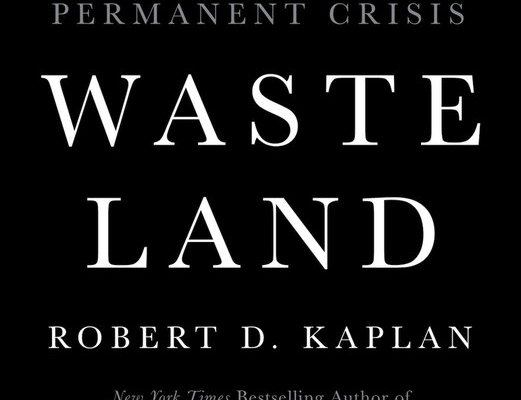
A review of Robert Kaplan, Waste Land. A World in Permanent Crisis. New York, 2025
By Arnout Nuijt
Robert Kaplan has built up an excellent reputation for decades when it comes to strong analyses of geopolitics. Never optimistic, but always realistic (in the eyes of some, that is pessimistic) the conservative journalist, geopolitical analyst and writer usually warns against an overly cheerful view of international developments and the resignation that usually accompanies it. We are used to pessimistic titles and ditto content from Kaplan (see The Coming Anarchy, Asia’s Cauldron, The Tragic Mind, etc.), but his latest book beats them all.
Waste Land. A World in Permanent Crisis is named after T.S. Eliot’s 1922 poem, which was of course inspired by the horrors of the First World War. In short, Kaplan’s argument revolves around a world that in his eyes has entered a Weimar phase, is armed to the teeth and internally divided to the bone. Globalization has also made the world much smaller and we are more exposed than ever to each other’s diseases, wars and other crises.
In addition, the three major powers, the US, Russia and China, are in decline for various reasons and are each suffering from a Shakespearean leadership crisis. In this exciting world, thanks to ever-increasing urbanization, we are also increasingly confronted with group think from both elites and the masses. Individuals are increasingly at risk of being excluded. The world is in permanent crisis because of all this, according to Kaplan. His book is not exactly cheerful.
Kaplan defends himself by noting that pessimism is indeed useful, because it leads to a better assessment of risks and possible crises. Regularly criticized for as demoralizing, Kaplan quotes the political scientist Samuel Huntington, who once rightly stated that it is not the job of the scientist or analyst to improve the world, but to tell us bluntly what he believes is actually going on. I have always enjoyed Kaplan’s work, which often focused concretely and regionally on geopolitical issues in regions such as the Indian Ocean, the Pacific or the Balkans. But his latest book deserves some comments.
The Weimar comparison is flawed
One of Kaplan’s starting points in Waste Land is the Weimar comparison mentioned above. Yes, after the German Empire lost the First World War, the country was turned into the Weimar Republic, a short-lived period that has come to symbolize a weak and failing democracy. After all, Weimar would collapse in less than a generation due to the rise of Adolf Hitler and his Nazis. And now, in Kaplan’s familiar pessimistic view of the world, the entire world has entered a Weimar phase.
This comparison is flawed in a number of ways. For example, there is currently no global crash and economic crisis such as that which preceded the rise of the Nazis. Kaplan also ignores recent views of historians on the Weimar Republic, while libraries have been filled with books on this subject. The otherwise very well-read Kaplan uses only a few famous but dated and in a sense literary sources for the interpretation of the Weimar period, including Alfred Döblin, Golo Mann, Solzhenitsyn, Spengler and Winston Churchill.
The Weimar Republic was doomed from the start by the suffocating reparations imposed on Germany under the Treaty of Versailles by the Entente. The country remained partly occupied and in 1923, a crisis year for Germany, the French army struck hard in the rebellious Ruhr area. The second half of the twenties, however, went reasonably well and was politically more stable, partly thanks to American financing of the reparations. But around 1930, that Atlantic relationship ran aground and the country also came under the rule of the authoritarian Hindenburg. We can read all about this with contemporary authors such as Adam Tooze. Another modern author, Frank McDonough, points out that the old pre-war Wilhelmian bureaucratic, military and judicial elite still called the shots behind the scenes in Weimar. The premature end of a crucial and stabilizing Atlantic relationship is of course food for thought for those who want to make Weimar comparisons today.
But where the comparison falls short most is in Kaplan’s statement that he does not see or expect a Hitler at all at the moment. That is of course reassuring for all of us, but then where does that Weimar comparison come from, which stands or falls with the rise of Hitler? Kaplan is not clear about this and we must assume that the Weimar comparison is mainly intended as clickbait to draw the attention of the (American) reader.
Globalization does not lead to a better world
Kaplan states that humanity on earth will form an increasingly concentrated, closed system, but strongly divided and armed to the teeth. Globalization, which according to Kaplan started in the nineties with the outsourcing of American industry, has made the world much smaller and made humanity more interconnected. That’s nice, but it means that we can infect each other with diseases at a rapid pace and that we all suffer if a crisis occurs somewhere in a faraway country. Globalization has actually increased geopolitical risks. A smaller world does not necessarily lead to a better world.
In itself, there is little to argue against that, but globalization is really older than the last few decades, at least if you do possess an American perspective. In colonial times, humanity became more connected to each other against its will. And that was not without danger. Even then, diseases were spread back and forth. Moreover, especially in the years leading up to the First World War, various European powers regularly ran the risk of going to war with each other because of differences of opinion about the possession of faraway places. Think of, for example, the Tangier crisis or the Fashoda incident. On the other hand, in the centuries before, Europe had become acquainted with coffee, potatoes, tomatoes, bananas, tea and other exotic products, while European factories produced for distant colonies. Newspaper readers and businessmen of that time knew exactly what was happening on the other side of the world.
Three major powers in decline
Another problem for the geopolitical world order, according to Kaplan, is the fact that the three major powers in this world are all in decline. This is partly due to having the wrong kind of leaders, he reasons, because they are an important factor in the decline of major powers. According to the author, the decline of the US already began under President Carter, but the country is still the most powerful in the world. Putin is exclusively focused on the restoration of the Russian/Soviet empire and with Xi, China has again entered Leninist waters. Both are destroying their country with their doomed leadership.
A new Cold War has emerged between China and the US, with no rules, an uncertain outcome and a great risk of a catastrophic conflict. According to Kaplan, the best we can hope for is a kind of Cuban Missile Crisis between the two countries, in which the threat of mutual destruction or enormous losses makes both countries come to their senses and they both take a step back. After this, a rules-based relationship could emerge for the coming decades. And with a bit of luck, China’s growing military power will then be brought to a standstill or even reversed, Kaplan hopes, who is abandoning his proverbial pessimism here.
For us Europeans, the author has bad news. Russia will continue to undermine Europe as long as it exists. Putin’s death will only cause chaos and produce a new military-nationalist regime for Russia. Kaplan does not rule out that Eastern Europe, the United Kingdom and Ukraine will form a subgroup within NATO.
Decline of journalism
Kaplan has no good words for the attitude of the contemporary press. The press no longer consists of observers, but is actively involved in politics and opinion formation, he argues. The public that used to think of itself as spectators has now been degraded to convicts in the arena. All opinions have also been globalized: you are for or against Israel, wherever you live in the world.
Group think is rampant, among elites and the masses, on both the left and the right. For Kaplan, the left is the most dangerous, because it demands that everyone conform to all its positions. If you don’t, you are eliminated as an individual or a group.
That in this way an unhealthy environment has been created, in which people have become afraid to contradict each other, needs no further explanation. Oswald Spengler foresaw it more than a hundred years ago and Kaplan quotes from Der Untergang des Abendlandes: “The press has become an army with journalists as officers and their readers as foot soldiers – there is no greater caricature of freedom of thought.”
How does Trump fit into this story?
The big problem with this book is the timing. It seems to have been written entirely before the re-election of Donald Trump. And that is a pity, because under Trump the old, post-war world order is being turned upside down and we can expect major changes – whether we like it or not. The conservative Kaplan is not a MAGA Republican and he seems to dismiss the period 2016-2020 as a one-off aberration of American politics. Still, it would of course have been interesting to read with Kaplan about Trump’s recent intentions.
But there is a certain underlying power in the pessimistic tone of Waste Land. It becomes clear to the reader once again that, in a world in permanent crisis, he will have to search for inspiration and that dot on the horizon himself. He will have to choose his own path amidst declining superpowers, risky globalization, Weimar-like situations, suffocating group think and doomed, Shakespearean leaders. Beautiful things will certainly come out of that.
This article was translated from the original Dutch version, as published in Wynia’s Week of Amsterdam. A Portuguese language version of this book review was published by Observador of Lisbon.
 Geopolitical Weekly